The
island of Japan forms an arc in the Pacific Ocean to the east of the Asian
continent. The land comprises four large islands name (in decreasing order
of size) Honshu, Hokkaido, Kyushu, and Shikoku, together with many smaller
islands. The Pacific Ocean lies to the east while the Sea of Japan and the
East China Sea separate Japan from the Asian continent.
Japan's
total land area is about 378,000 square km, which is approximately the same size
as Germany, Finland, Vietnam, or Malaysia. As warm ocean current known as
the Kuroshio flows northeastward along the southern part of the Japanese
archipelago, and a branch of it, known as the Tsushima Current, flows into the
Sea of Japan along the west side of the country. From the north, a cold
current known as the Oyashio flows south along Japan's east coast, and a branch
of it, called the Liman Current, enters the Sea of Japan from the north. The
mixing of these warm and cold currents helps produce abundant fish resources in
waters near Japan.
About
3/4 of Japan's land surface is mountainous. The Chubu Region of central
Honshu is known as the "roof of Japan" and has many mountains which
are more than 3,000 meters high. Japan's highest mountain is Mt. Fuji
(3,776 m) with Kitadake at 3,192 m being the second highest.
Since it is
situated along the circum-Pacific volcanic belt, Japan has several volcanic
regions - usually considered to number 7- from the far north to the far
south. Of all the volcanoes, about 80 are considered active, including Mr.
Mihara, Mt. Asama and Mr. Aso. Incredibly, Japan has about 1/10 of the
world's approximately 840 active volcanoes, this in spite if it's small land
area (about 1/400 of the world's land area). Mt. Fuji, which as been
dormant for almost 300 years, is still capable of erupting again in our
lifetime. All the instability under the Japanese archipelago is conducive
for earthquakes, thus placing Japan among those countries most likely to suffer
from them.
|
|
Overview
The
island of Japan forms an arc in the Pacific Ocean to the east of the Asian
continent. The land comprises four large islands name (in decreasing order
of size) Honshu, Hokkaido, Kyushu, and Shikoku, together with many smaller
islands. The Pacific Ocean lies to the east while the Sea of Japan and the
East China Sea separate Japan from the Asian continent.
Japan's
total land area is about 378,000 square km, which is approximately the same size
as Germany, Finland, Vietnam, or Malaysia. As warm ocean current known as
the Kuroshio flows northeastward along the southern part of the Japanese
archipelago, and a branch of it, known as the Tsushima Current, flows into the
Sea of Japan along the west side of the country. From the north, a cold
current known as the Oyashio flows south along Japan's east coast, and a branch
of it, called the Liman Current, enters the Sea of Japan from the north. The
mixing of these warm and cold currents helps produce abundant fish resources in
waters near Japan.
About
3/4 of Japan's land surface is mountainous. The Chubu Region of central
Honshu is known as the "roof of Japan" and has many mountains which
are more than 3,000 meters high. Japan's highest mountain is Mt. Fuji
(3,776 m) with Kitadake at 3,192 m being the second highest.
Since it is
situated along the circum-Pacific volcanic belt, Japan has several volcanic
regions - usually considered to number 7- from the far north to the far
south. Of all the volcanoes, about 80 are considered active, including Mr.
Mihara, Mt. Asama and Mr. Aso. Incredibly, Japan has about 1/10 of the
world's approximately 840 active volcanoes, this in spite if it's small land
area (about 1/400 of the world's land area). Mt. Fuji, which as been
dormant for almost 300 years, is still capable of erupting again in our
lifetime. All the instability under the Japanese archipelago is conducive
for earthquakes, thus placing Japan among those countries most likely to suffer
from them.
Back
to Top
GEOGRAPHY
Japan is an island with a coastline
ranging from long, sandy beaches to areas with steep cliffs. The country
forms an arc and contains four large islands and many smaller ones.
Approximately the same size as Malaysia or Germany, Japan has a total land area
of about 378,000 sq km. To put it into further perspective, it's smaller
than the state of California and about 1/25 the size of the United States.
On Japan's east is the Pacific
Ocean and on the west is the Sea of Japan and the East China Sea. These
two seas, incidentally, are all that separate Japan from China. Being in
the middle of all these bodies of water with their warm and cold currents has
it's advantages, a great abundance of fish! The currents flow in different
directions around Japan. The warm currents flow from the southern part of
Japan, northward with a cold current flowing from the north going south.
These currents split, thus branching off and flowing on both the east and west
side of Japan.
Back
to Top
VOLCANOES AND EARTHQUAKE
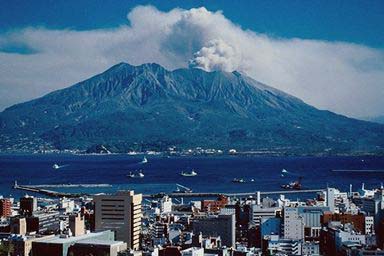
Volcano Sakurajima Kagoshima
The majority of Japan's land is
mountainous, totaling approximately 75%. Central Honshu's Chubu Region is
incredible with many mountains exceeding 3,000 in height, which is why it's
aptly named "the roof of Japan".
The highest mountain in Japan is
Mt. Fuji, at an impressive 3,776 meters. Mt. Fuji can be found bordering
the Yamanashi and Shizuika Prefectures. It's easy to forget that
this impressive and beautiful mountain is actually a volcano. Although it
hasn't erupted since 1707, Mt. Fuji is not considered a dormant volcano and
could erupt again in the future.
Actually, many mountainous
regions, about seven of them, are considered to be volcanic. These regions
go from the far north all the way down to the far south. The reason for
the high number of volcanic areas is because Japan is located along the
circum-Pacific volcanic belt. Of the 840 active volcanoes in the world,
Japan has almost 1/10 of them (approximately 80) even though Japan has only
1/400 of the world's land area! A
positive aspect of volcanoes is the money brought in by tourists. Tourists
go to see the beautiful scenery and go to the surrounding hot springs as well.
It is apparent by all Japan's
volcanoes that there is a lot of instability in the Earth's crust below.
This instability, and high energy, attributes to the approximately 1,000
earthquakes Japan experiences every year. Most of these are not serious
and don't cause extensive damage, but are simply those that are strong enough to
be felt.
Back
to Top
CLIMATE
A major feature of Japan's climate is the clear-cup
temperature changes between the four seasons. From north to south, Japan
covers a range of latitude of some 25 degrees and is influenced in the winter by
seasonal winds blowing from Siberia and in the summer by seasonal winds blowing
from the pacific Ocean. In spite of it's rather small area, Japan is
characterized by four different climatic patterns.
Hokkaido, with a subarctic weather pattern, has a
yearly average temperature of eight degrees centigrade and receives an average
annual precipitation of 1,150 millimeters. The Pacific Ocean side of
Japan, from the Tohoju region of northern Honshu to Kyushu, belongs to the
temperate zone, and its summers are hot, influenced by seasonal winds from the
Pacific. The side of the country which faces the Sea of Japan has a
climate with much rain and snow, produced when cold. moisture-bearing seasonal
winds from the continent are stopped in their advance by the Central Alps and
other mountains which run along Japan's center like a backbone, The
southwestern islands of Okinawa Prefecture belong to the subtropical climate
zone and have a yearly average temperate of over 22 degrees, while
receiving over 2,000 millimeters of precipitation.
Back
to Top
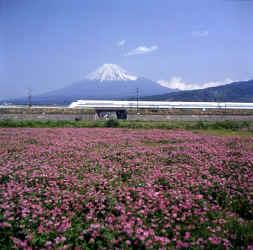
Spring (March, April,
May)
When
winters nears its end, the cold seasonal winds blowing from the continent become
weaker and more intermittent. At this time, low pressure air masses
originating in China enter the Sea of Japan; these give rise to strong, warm
southerly winds which travel toward this low-pressure zone from the Pacific
Ocean. The first of these winds is called haru ichiban. While
it announces the warmth of the coming spring, it sometimes causes avalanches
and, crossing the mountains to the side of the country facing the Sea of Japan,
it is at times responsible for exceptionally hot and dry weather and can even
become the cause of large fires.
In early spring, plum blossoms appear, followed by
peach blossoms. During the last ten days or so of March, the cherry
blossoms so beloved by the Japanese people begin to bloom.
Back
to Top
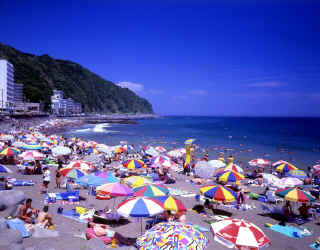
Summer (June, July,
August)
Before the
arrival of real summer-like weather, Japan has a damp rainy season know as baiu.
From May until July, there is a high-pressure mass of cold air above the Sea of
Okhotsk to the north of Japan, while over the Pacific Ocean there develops a
high-pressure mass of warm, moist air. Along the line where these cold and
warm air masses meet, known as the baiu zensen, which extends from
southern China over the Japanese archipelago, causes prolonged periods of
continuous rainfall.
After the middle of July, high-pressure air masses
over the Pacific Ocean become predominant and the rainy season comes to an end
as the baiu zensen is pushed northward. Seasonal winds from the
Pacific Ocean bring warm, moist air to Japan, and the country has hot summer
weather with many days when temperatures rise to more than 30 degrees
centigrade.
Back
to Top
Autumn (September, October,
November)
From the end of summer through September, Japan is often struck by
typhoons. Typhoons originate from large masses of tropical low-pressure
air in the North Pacific between the latitudes of approximately 5 and 20
degrees, and are the same phenomenon as hurricanes and cyclones in other parts of
the world. When a typhoon begins to take shape, it gradually moves
north. Every year, during this period, around 30 typhoons form, of which
on the average about 4 reach Japan, sometimes causing great destruction.
After the middle or latter part of October, Japan
enjoys generally clear weather; it is neither hot nor cold. The country
also enjoys especially fine weather at the beginning of November. Many of
the trees take on bright autumn colors, making this time of the year, together
with the time of new greenery in the spring, a truly beautiful season.
Back
to Top
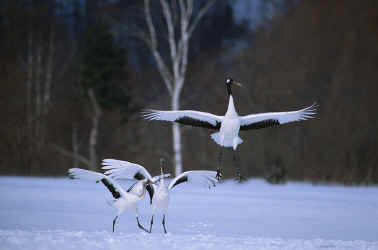
Winter (December, January,
February)
Toward
the end of November, cold seasonal winds begin blowing over Japan from the
continent. These northwesterly winds pick up moisture over the Sea of
Japan and drop much of this moisture in the form of rain and snow on the western
side of Japan as they are impeded in their eastern advance by the ridge of
mountains that runs through the central part of the country. The Hokuriku
region (Fukui, Ishikawa, Toyama, and Niigata prefectures), which faces the Sea
of Japan and is separated from other regions of Japan by high mountains, is
known for its deep snows.
By contrast, the Pacific side of the country enjoys
generally clear skies during the winter season. In Tokyo, despite the fair
skies, winter temperatures average around 5 degrees, a difference of 25 degrees
from summer temperatures of 30 degrees or more.
The islands of Okinawa Prefecture in the far
southwest have a subtropical climate with less marked temperature differences
between the seasons. Winter temperatures there are much more moderate than
in other parts of the country.
Back
to Top
Information provided by the
Japanese Embassy
|