Japan's
education system played a central part in
enabling the country to meet the challenges
presented by the need to quickly absorb Western
ideas, science and technology, and it was also a
key part in Japan's recovery and rapid economic
growth in the decades following the end of World
War II.
After
WWII, the Fundamental Law on Education and the
School Education law were enacted in 1947 under
the direction of the Occupation forces.
The latter law defined the system that is still
in use today: six years of elementary school,
three years of junior high school, three years
of high school, two or four years of university.
Elementary and junior high school attendance is
compulsory.
Education
prior to elementary school is provided at
kindergartens and day-care centers. Public
and private day-care centers will take children
from under age one on up to 5 years old.
The programs for those children ages 3-5
resembles those at kindergartens. The
educational approach at kindergartens various
greatly from unstructured environments that
emphasize play to highly structured environments
that are focused on having the child pass the
entrance exam at a private elementary school.
Back
to Top
HISTORY
Education
in reading and writing has existed in some form
since the introduction of Chinese writing and
Buddhism in the 6th century. In 701, the
Taiho Code established schools for the children
of the nobility, in both the capital and the
provinces. Beginning in the Jamakura
period (1185-1333), an increasing number of the
children of the samurai received formal
education, but it was not until the 250 years of
peace of the Edo period (1600-1868) that
education became widespread among both the elite
and the common people.
Education
in the Edo period was basically Confucian
concepts that emphasized rote learning and study
of the Chinese classics. Two main types of
schools develops. The first type was the
domainal schools (hanko) that existed in more
than 200 domains by the end of the period and
provided education primarily to children of the
samurai class. The second type the the terakoya
schools, which enrolled the children of
commoners as well as samurai and concentrated on
moral training and teaching reading, writing,
and arithmetic. Terakoya were usually run
by a single teacher of a married couple, and
there were tens of thousands of these schools in
existence at the end of the Edo period.
Japan's
literacy rate at the time of the collapse of the
Tokugawa shogunate in 1868 is estimated at 40
percent, a level that compares favorably with
many Western nations at the time. Without
this educational foundation, the rapid
modernization achieved in the following years
would not have been possible.
The Meiji
leaders wanted to develop and begin an
educational system that would make it possible
for Japan to unite as well as bring the country
up to the western standard. Their system
established three levels: primary school,
middle school, and university. Both boys and
girls were required to attend school at the
primary level.
The close
World War II brought about change in Japan's
educational system. With the assistance
Occupation forces, two laws were enacted, the
Fundamental Law on Education and the School
Education Law. The School Education Law is
the one that defined the current educational
system in Japan. This educational system
includes six years of elementary school, three
years of junior high school, three years of high
school and two or four years of university.
Elementary and Junior High attendance is
required for all students.
Back
to Top
SCHOOLS
AND CURRICULA
There are
three terms for most elementary, junior high,
and high schools, with April 1 being the
beginning of the school year. The three
terms are from April to July, September to
December, January to March. Saturday
morning attendance is still seen in some areas
(as of 1998), but many have changed to a five
day school week and some schools have two terms
instead of three. In comparison to other
industrial nations, the Japanese study more than
those elsewhere, but it is unknown whether this
number is due to shorter summer vacations or
more homework.
Back
to Top
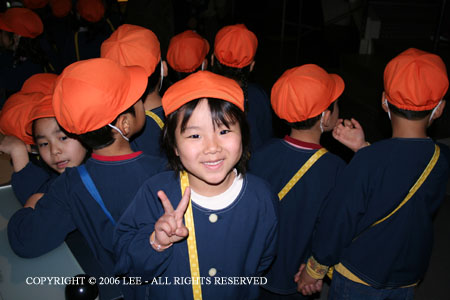
Preschool
Education: For those who wish to start their
children in a school environment early,
kindergartens are available. There are also
public and private day-care centers that will
take children who are less than a year old and
on up to five years of age. These
programs, at least for the children in the 3-5
year range, are comparable to kindergartens.
Kindergartens are not all alike and will vary
from being very structured and focused on
learning, while others are more for social
interaction or play and are basically
unstructured.
Back
to Top
Elementary
Schools:
Elementary education is compulsory for all six
years. The Ministry of Education defines
the elementary school curricula and makes it
uniform throughout Japan, thus all students in
one grade are studying the same subjects.
The following subjects are included in the
national curriculum: Japanese language, social
studies, arithmetic, science, life environmental
studies, music, arts and craft, physical
education and homemaking. In addition,
there is an hour a week of moral education as
well as extracurricular activities. The most
important part of the curriculum, on the
elementary level, is reading and writing.
Not only are children required to learn Japanese
they are also required to learn, by the end of
the sixth grade, a minimum of 1006 Chinese
characters.
Back
to Top
Junior
High Schools:
Attendance is compulsory for the three years of
junior high as well. Although the subjects
taught are specified by the Ministry of
Education, teachers are allowed leniency in
defining the specific topics that are covered in
their classes. The standard curriculum for the
junior high level requires the following
subjects: Japanese language, social studies,
mathematics, science, music, fine arts, health
and physical education, and industrial arts or
homemaking. There are also electives in
foreign language (usually English),
extracurricular activities as well as an hour
per week of moral education.
Back
to Top
High
Schools:
Attendance in high school is not compulsory and
most of the high schools are run by prefectural
boards of education. Entrance into high
school can be intensely competitive, especially
in the popular schools, and is based on how the
prospective student performs on an entrance
exam. The schools that are the most
popular tend to be the ones where graduates get
into the "better" universities.
Enrollment is highest in general academic
courses, but other programs are offered like
those specialized in the vocational area.
The curriculum for high school is comprised of
required subjects and electrives comprised of
the following: Japanese language, geography and
history, civis, mathematics, science, health and
physical education, art, foreign languages and
home economics.
Back
to Top
Universities:
A little less than half of all high school
graduates attended a two-year junior college or
four-year university. Most of the junior
college graduates are women. Most of the
universities and junior colleges are private and
in 1996, almost 10 percent of the 4 year
graduates went on fur further education
(graduate school).
Competition
is intense for top-level schools. The
biggest factor creating this competition is the
name value associated with the university, the
better the name the better the chances of
getting a good job after graduation.
Competition is so fierce that if a high school
graduate doesn't get into the college of his/her
choice, they will study to try again the next
year.
Back
to Top
ISSUES
IN JAPANESE EDUCATION
Examination
Hell:
Competition is so intense with the high school
and university entrance exams it is called
"examination hell." This
competition is caused by wide spread problems in
the schools themselves and in society. The
major corporations in Japan do nothing to help
this problem because they tend to chose recruits
from a small select group of universities.
This then creates the impression that if you
want to get anywhere after graduation, you go to
one of those universities. Most of the
admissions exams are simply multiple choice
questions, though a few many include essays or
performance tests.
A
large number of elementary and junior high
students attend schools in the evening to be
tutored or to "cram". They do
this in the hopes that they will improve their
performance on the required entrance exam.
Unfortunately, a side effect of all this
competition is severe stress that comes out by
bullying, violence and "allergies to
school". Children are refusing to go
to school for emotional reasons, thus the saying
"school allergy", as early as the
elementary school years! The bullying and
violence are the causes of suicide and murder in
the junior and high schools across Japan.
Some blame the parents for this behavior and
others blame the education system for it's
strictness and extreme pressure regarding
examination performance.
Back
to Top
Information
provided by the Japanese Embassy